Brazil votes in tight presidential run-off between Lula and Bolsonaro's son
Brazilians head to the polls on Sunday in a closely fought contest between the 80-year-old left-wing incumbent and right-wing senator Flavio Bolsonaro, who led the first round.
By True Herald Wire Staff ·
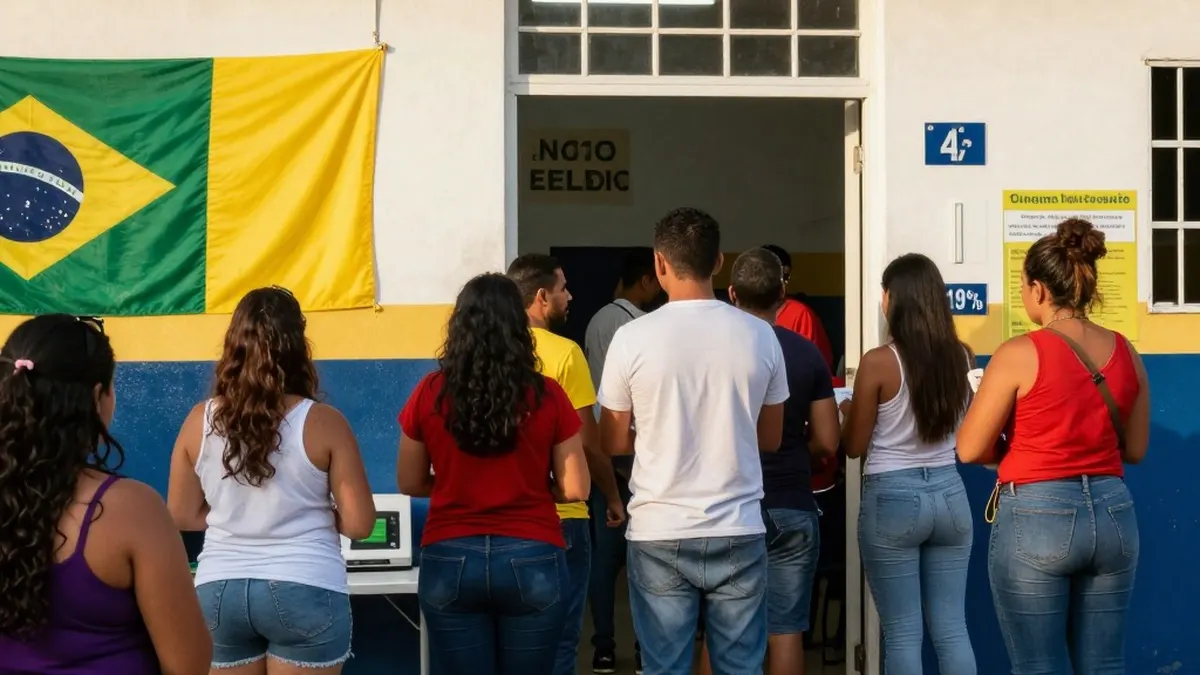
Brazilians go to the polls on Sunday to elect a new president in a closely fought run-off election. The contest pits the 80-year-old incumbent, left-winger Luiz Inacio Lula da Silva, who is seeking a fourth non-consecutive term in office, against right-wing senator Flavio Bolsonaro, 45.
Bolsonaro is the son of former right-wing president Jair Bolsonaro, who is serving a 27-year prison sentence for plotting a coup after losing the last election in 2022. The elder Bolsonaro is serving his sentence under house arrest due to ill health, and his son has pledged to release him.
The younger Bolsonaro enters the vote as the front-runner after coming top in the first round on 4 October, a result US President Donald Trump called a "very big" victory. Never before has a candidate who trailed after the first round managed to overturn the deficit and win in the second round.
At his final campaign rallies, Bolsonaro's supporters were jubilant, confident he would bring change through a promised tough crackdown on organised crime, as well as tax and public spending cuts. He campaigned on the eve of polls in Belo Horizonte, the capital of Minas Gerais, a must-win state for any presidential hopeful since the 1980s. "The time is almost here," Bolsonaro told supporters in a social media video. "There are only a few hours left before we shape the future of our nation for the next 30 or 40 years."
In Barra de Tijuca, the Rio de Janeiro neighbourhood where Jair Bolsonaro has a home, backers rallied in the national colours. "Brazil needs change, and Flavio is the person that represents that today, after so many years of the Left destroying the economy and the country," one told BBC News. Another said what she most liked about Flavio Bolsonaro was his promise to "end violence in Brazil, end terrorism, narco-trafficking, and to reduce interest rates".
Since Bolsonaro's first-round victory, Lula's supporters have arranged huge rallies to try to boost turnout after 33 million people did not cast a vote earlier this month. On Saturday, Lula told a huge crowd on Rio de Janeiro's Copacabana beach that this election was a matter of "sovereignty", saying people would choose between the one who kissed the Brazilian flag or the American flag. His administration has accused the US of interfering in Brazil's election, an allegation Washington has called "baseless".
"We're going to win the election for one simple reason: it's true that the people want change [but] they want to move forward," Lula said. "They don't want to go backward." A supporter called Roberta told BBC News: "This movement is to show we have strength. We've woken up, we're coming to the street to make a difference and turn the vote around." A man wearing Brazil's national yellow and green football shirt said Bolsonaro supporters had "appropriated" the jersey but Lula supporters were taking it back.
Lula and his Workers' Party have cast this election as a "battle for democracy", arguing that Jair Bolsonaro's conviction for coup-plotting is evidence that "Bolsonarismo" constitutes a threat to Brazil's democratic institutions. Bolsonaro, in turn, has been labelling the Workers' Party as corrupt, reminding voters of the massive financial scandals which plagued the party for years and which have turned many voters against it.
During Lula's latest term in office, relations with Trump have been rocky. Lula has insisted that Brazil "does not fit into anyone's backyard", an apparent reference to what Trump has dubbed the "Donroe Doctrine", his administration's national security strategy which asserts that US dominance in the Western hemisphere should not be interfered with. Bolsonaro, on the other hand, argues that working with Washington to combat powerful criminal gangs, which wield immense power in parts of Brazil, will restore the state's sovereignty to gang-controlled areas.
Lula plans to be in Sao Paulo to watch the results on Sunday evening, while Bolsonaro is set to be in the capital Brasilia, which is also where his father is under house arrest.
Source: BBC News