Eight Dead as Gunmen Strike Greek Orthodox Church in Jordanian Karak
Security forces are hunting three suspects after a fatal shooting during a funeral in a region known for long standing interfaith coexistence.
By Tariq Mahmoud ·
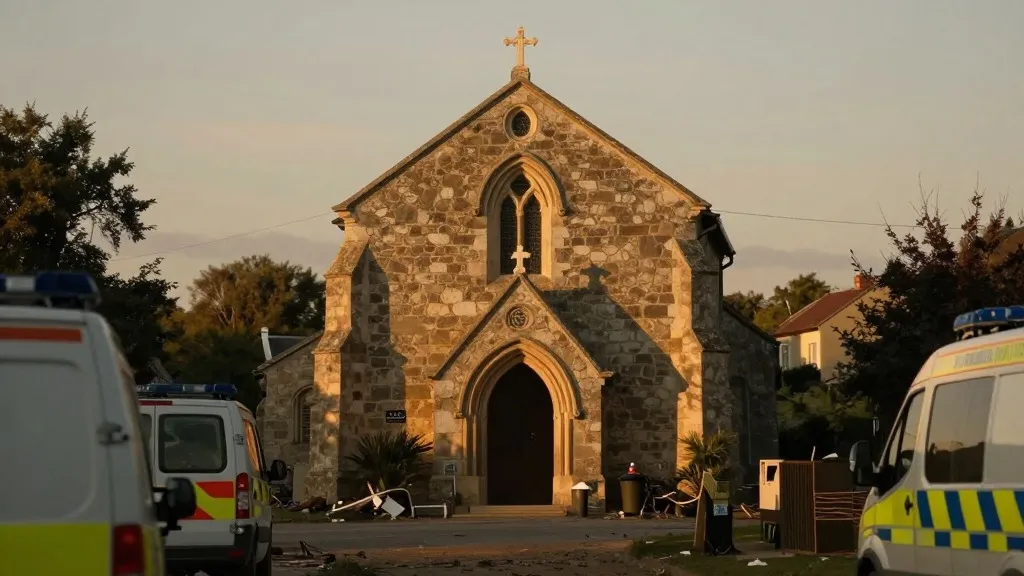
A violent rupture in the social fabric of Jordan’s south occurred Friday when three gunmen targeted a place of worship, leaving eight people dead and dozens injured. The attack, which officials have classified as an act of terror, struck at the heart of a community in Karak governorate that has long defined itself by the close coexistence of its Christian and Muslim residents. The timing of the assault, during a funeral service, amplified the sense of shock as the congregation gathered in mourning rather than in celebration.
The sequence of events began in the afternoon at a Greek Orthodox church in the village of Hamoud. Survivors reported hearing an explosion shortly after the service started. Two men arrived by vehicle and were soon joined by a third individual carrying a semi-automatic rifle. The group entered the building and opened fire for several minutes. Nasser al-Burqan, a lawyer who survived the incident, stated that one attacker fired a handgun at him from a distance of about two metres. His son, who was also present, was shot in the leg and transported to a hospital for treatment.
Jordan has a history of handling security threats, yet this specific type of violence at a church is rare in the kingdom. In 2016, the ISIL group conducted a series of attacks in the Karak area, including a siege of a medieval castle that resulted in ten deaths. That event involved a prolonged standoff with security forces. The current incident marks a significant escalation in the frequency of such targeted strikes in recent years.
King Abdullah II responded to the tragedy by offering condolences to the bereaved families. He declared that those responsible would face the harshest penalties and ordered a comprehensive review of the national security procedures used to respond to terrorist attacks. The government has described the attackers as unknown assailants, though Interior Minister Mazin Al-Farrayeh attributed the violence to a group of extremists. Prime Minister Jafar Hassan characterized the event as a product of blind extremism and terrorist ideology, although the specific motive remains under investigation.
The human cost of the attack is significant. According to the Ministry of Health, seven individuals died at the scene, while an eighth victim, a woman, succumbed to her injuries hours later. Of the forty people wounded, twenty-seven remain hospitalized. A director at Prince Ali Military Hospital in Karak noted that one patient is in critical condition following surgery. Tarek Ammarin, who was visiting an injured relative, described the scene as a massacre in every sense of the word.
Looking ahead, the focus shifts to the ongoing manhunt and the broader implications for regional stability. Security camera footage released by state channels shows the three men firing outside the church and targeting a group of men attempting to flee. The Karak region, located about 120 kilometers south of Amman, is home to a large portion of Jordan’s 300,000 Christians. Despite the violence, community leaders suggest that the attack may strengthen rather than weaken the bonds of interfaith solidarity that have persisted for generations.
The nation declared three days of mourning, with flags flying at half-mast over public buildings. International reactions have been swift, with condolences and condemnations arriving from countries including Iraq, Poland, and Qatar. Ahmed al-Tayeb, the grand imam of Cairo’s Al-Azhar, called the event a heinous terrorist attack. As Jordan continues its search for the gunmen, the incident serves as a stark reminder of the security challenges facing working families and religious minorities in the region.
Source: Al Jazeera